The Jacobite Cause: An Introduction
The term 'Jacobite' describes one of the most dramatic political and military movements in British history: the effort to restore the Stuart dynasty to the thrones of England, Scotland, and Ireland following the deposition of King James II in 1688. From the first rising in 1689 to the final defeat at Culloden in 1746, the Jacobite cause shaped the politics, warfare, and culture of Britain and Ireland for over half a century.
The word itself comes from 'Jacobus' — Latin for James — and refers to adherents of James and his heirs.
The Causes of the Jacobite Rebellions
The Deposition of James II (1688)
James II (also James VII of Scotland) succeeded to the throne in 1685 on the death of his brother Charles II. He was openly Catholic — a serious problem in a kingdom whose law barred Catholics from holding civil or military office. His reign was marked by attempts to extend toleration for Catholics and Dissenters, use of royal prerogative to override parliamentary restrictions, and the appointment of Catholics to key positions in defiance of the Test Acts.
Protestant anxiety reached a crisis point in June 1688 with the birth of James's son, James Francis Edward Stuart. This meant a Catholic succession — potentially stretching indefinitely into the future. Leading Protestant politicians, known as the 'Immortal Seven', sent a formal invitation to William of Orange — Protestant prince of the Netherlands and husband of James's Protestant daughter Mary — to invade.
William landed in November 1688 with a Dutch army. James's support collapsed. He fled to France in December 1688 — the Glorious Revolution — and William and Mary were offered the crown jointly by Parliament.
The Jacobites rejected this as illegal. They held that James had not abdicated voluntarily — his flight was forced — and that the crown could not be given by Parliament but only descended by hereditary right to the next legitimate heir.
The Act of Settlement 1701
The Act of Settlement 1701 excluded Catholics from the line of succession and settled the crown (after William III and the childless Anne) on the Protestant Sophia of Hanover and her heirs. On Anne's death in 1714, this brought the German Hanoverian line — as George I — to the British throne, entirely bypassing some 57 individuals with stronger hereditary claims who were Catholic.
This Act was the constitutional foundation of the Hanoverian monarchy and the direct reason why the Stuart claim was repeatedly denied. The Jacobites saw it as a fundamentally illegitimate piece of legislation.
The Act of Union 1707
The Acts of Union 1707 created the Kingdom of Great Britain by merging the separate Scottish and English Parliaments. Many Scots opposed the Union, particularly as the terms were seen as unfavourable to Scotland. Scottish Jacobitism drew partly on this resentment: a Stuart restoration was associated in many minds with undoing the Union and restoring Scottish autonomy.
The Five Jacobite Risings
1689: The First Rising — Killiecrankie
Immediately after William and Mary took the throne, the first Jacobite rising erupted in Scotland. John Graham of Claverhouse, Viscount Dundee ('Bonnie Dundee') raised the Highland clans for James VII. He won a decisive battle at the Pass of Killiecrankie in July 1689, routing the government forces — but was killed in the moment of victory. Without Dundee's leadership, the rising could not sustain momentum. The Jacobite army was defeated at the Battle of Dunkeld in August 1689 and the rising collapsed.
James II's position in Ireland was separately contested. William III defeated James at the Battle of the Boyne (1 July 1690), and James fled permanently to France. He died there in 1701.
1708: The Failed Invasion
In 1708, France and Britain were at war (the War of Spanish Succession). France assembled a fleet to carry James Francis Edward Stuart — 'The Old Pretender', the man James II's supporters called James III — to Scotland. The fleet reached the Firth of Forth but was intercepted by the Royal Navy and scattered. James never landed. The invasion was aborted without a shot being fired.
1715: The Fifteen
The largest of the early risings, the Fifteen erupted in the year following George I's accession. The Earl of Mar raised the standard at Braemar in August 1715 with substantial Highland and north-eastern Scottish support. A simultaneous rising in northern England was coordinated.
The key battle was Sheriffmuir (13 November 1715), a confused encounter near Stirling that was essentially a draw — each side winning on one flank and losing on the other. James Francis Edward Stuart arrived in Scotland in December 1715, too late and offering too little inspiration. The rising gradually collapsed; James retreated to France in February 1716. The Fifteen was the only rising in which the Old Pretender himself set foot in Scotland.
1719: The Nineteen
A Spanish-backed expedition landed a small force in the north-west of Scotland in 1719. The main French invasion fleet, intended to accompany it, had been largely destroyed by storms. The small Spanish-Jacobite force was defeated at the Battle of Glenshiel in June 1719 and the rising collapsed. This was the last attempt at an externally backed rising until 1745.
1745: The Forty-Five
The greatest and final Jacobite rising, the Forty-Five was led by Charles Edward Stuart ('Bonnie Prince Charlie'). It began with the raising of the standard at Glenfinnan on 19 August 1745, saw the capture of Edinburgh, the victory at Prestonpans, the advance into England as far as Derby, the retreat, and finally the decisive defeat at Culloden on 16 April 1746.
For a full account, see our articles on Bonnie Prince Charlie and the Battle of Culloden.
Final Defeat and Legacy
Culloden ended the Jacobite military threat permanently. The systematic repression that followed — the Disarming Acts, the abolition of heritable jurisdictions, the banning of tartan — dismantled the Highland social structure that had sustained Jacobite risings. Charles Edward Stuart died in Rome in 1788 without legitimate heirs. His brother Henry died in 1807, the last male Stuart in direct line. The Stuart cause was extinguished.
But the Jacobite legacy proved remarkably durable in culture and memory. Walter Scott's novels romanticised the Highland past and the lost Jacobite cause. Queen Victoria's passionate engagement with Highland culture — tartan, Balmoral, the myths of the clans — gave the romanticised version of Jacobite Scotland a new lease of life.
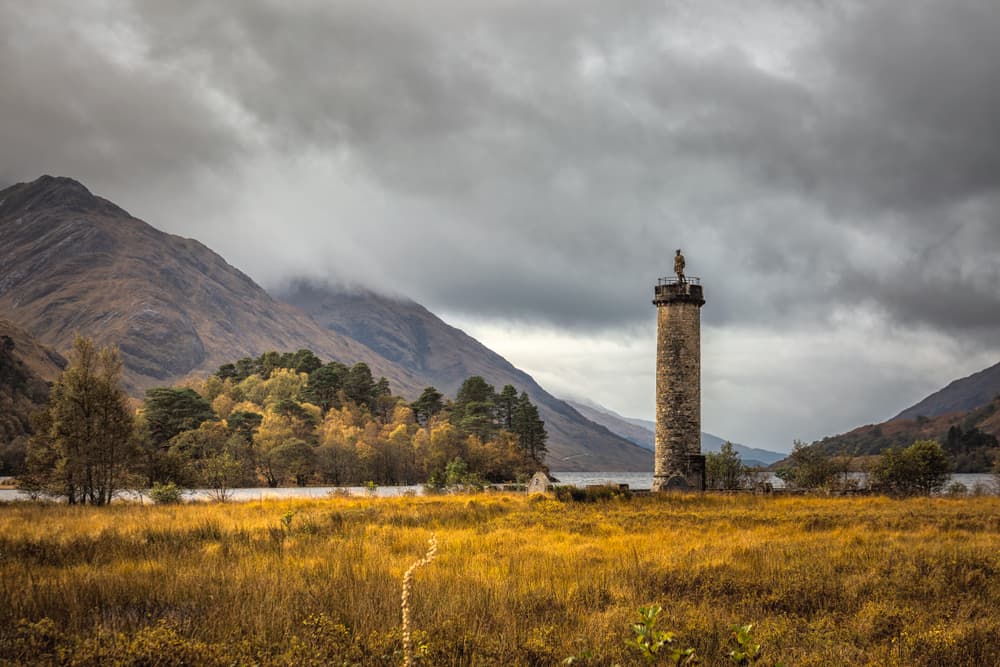
The Jacobite story endures not as a live political programme but as a powerful cultural memory: of loyalty, sacrifice, lost causes, and the destruction of a Highland world. The steam train crosses the viaduct at Glenfinnan, and the monument stands at the head of Loch Shiel, and people still come to look — and to remember.