Glenfinnan — Gateway to the Jacobite Story
Glenfinnan occupies one of the most historically charged landscapes in Scotland. Set at the head of Loch Shiel, where the narrow valley opens onto the loch's shimmering surface, it is a place of extraordinary natural beauty and deep historical resonance. Two things bring visitors here from around the world: the Glenfinnan Viaduct and the Glenfinnan Monument. Both reward the journey.
Glenfinnan is 17 miles west of Fort William on the A830 — the Road to the Isles — and the drive alone is worth making. The road follows the shore of Loch Eil before climbing through moorland and descending into the Glenfinnan valley, revealing the viaduct and the loch in a single sweeping panorama as you come over the rise.
The Glenfinnan Viaduct
The Glenfinnan Viaduct is the most photographed railway structure in Scotland and arguably one of the most famous in the world. Built between 1897 and 1901 as part of the Mallaig Extension of the West Highland Railway, it was designed by Robert McAlpine — known as 'Concrete Bob' — and was one of the first large-scale uses of mass concrete in British railway construction. The viaduct has 21 arches and curves gently across the valley of the River Finnan, reaching a maximum height of approximately 30 metres above the valley floor.
The curve is what makes the viaduct so visually compelling. From the classic upper viewpoint on the hillside opposite, you can see the locomotive pulling the full length of the train around the bend, with steam or smoke drifting across the arches and the Highland landscape stretching behind. No photograph fully does it justice.
The viaduct is on the active railway and cannot be walked across, but you can walk underneath it via a path that leads from near the visitor centre car park. Looking up at the arches from below gives a real sense of the structure's scale.
The Best Viewpoints
The classic upper viewpoint is reached by following the footpath that leaves from near the main car park, crossing the road and climbing steadily up the hillside opposite the viaduct. The walk takes approximately 15–20 minutes at a moderate pace. The path is well worn but steep in places and can be slippery after rain — good footwear is recommended. From the top, you have an elevated view across the full curve of the viaduct, down the length of Loch Shiel, and up to the surrounding mountains.
A lower viewpoint, closer to ground level, is accessible from the roadside and gives a different perspective on the viaduct. This is better for those with limited mobility and gives a closer view of the arches themselves.
The visitor centre car park also offers a more distant but still rewarding view of the viaduct across the valley.
For comprehensive photography guidance, see our Glenfinnan Viaduct viewpoint guide.
The Glenfinnan Monument
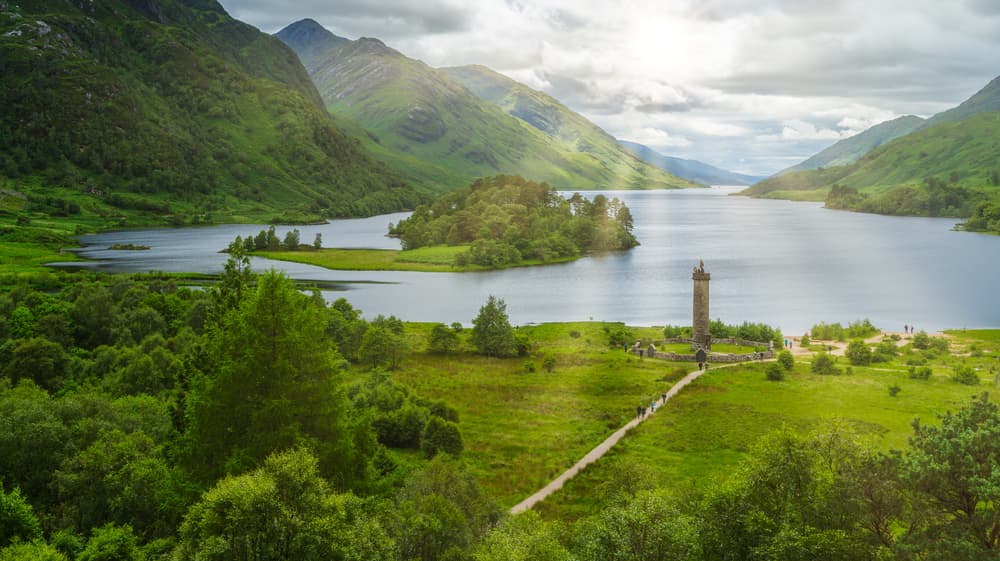
Standing at the head of Loch Shiel, the Glenfinnan Monument is a tall round tower topped with the figure of a Highlander. Erected in 1815 by Alexander MacDonald of Glenaladale — a descendant of one of the original 1745 supporters — it marks the spot where Charles Edward Stuart raised the Stuart standard on 19 August 1745, beginning the last Jacobite Rising. It was designed by architect James Gillespie Graham.
A common misconception: the figure on top of the monument is a generic Highland soldier, not Bonnie Prince Charlie.
The monument is on a National Trust for Scotland property. The visitor centre at the base houses an excellent exhibition on the 1745 Rising and the Jacobite cause. The tower itself is open seasonally and a small admission fee applies to enter and climb to the viewing platform — the views from the top across Loch Shiel are spectacular.
See our Glenfinnan Monument guide for full details.
Loch Shiel
Loch Shiel stretches 28 kilometres south-west from Glenfinnan. It is a narrow, deep freshwater loch surrounded by steep mountains on both sides, with no road along most of its length — which preserves its wild, unspoilt character. The views from the shore at Glenfinnan down the length of the loch, with the monument in the foreground, are among the most iconic in Scotland.
The loch is a popular fishing destination (salmon and brown trout). Boat trips are available seasonally from Glenfinnan to Acharacle at the southern end of the loch. This is a quieter and less-visited experience, but the scenery from the water looking back towards Glenfinnan is exceptional.
Managing the Crowds
Glenfinnan is one of the most visited spots in the Scottish Highlands, and in peak season — particularly July and August — it can become very busy around the time the westbound Jacobite passes. The car park fills quickly from around 09:30 onwards on summer days.
To avoid the worst of the crowds, aim to arrive before 09:30 or after 13:00. Early morning visits offer the best light for photography (particularly in summer when the sun is low in the east), fewer people, and a better chance of mist in the valley — which adds dramatically to the atmosphere. If you arrive after 13:00, the main crowd wave from the westbound train has dispersed, though the car park may still be busy.
Visiting in September or early October is an excellent way to experience Glenfinnan with fewer crowds and exceptional light. The autumn colours on the surrounding hillsides come into full effect in October. The Jacobite is still running (season ends 23 October 2026), so you can still see the train.
Getting There
By car: From Fort William, take the A830 west. Glenfinnan is 17 miles and approximately 25–30 minutes drive. The road is mostly single-track with passing places west of Banavie — drive with care and give way appropriately. The Glenfinnan Monument Car Park postcode is PH37 4LT (What3Words: ///avid.prevents.blotting).
By train: The Jacobite itself stops at Glenfinnan — this is the only regular passenger train service to the village. Boarding the Jacobite at Fort William for Glenfinnan is an excellent option, giving you a couple of hours to explore before the eastbound return service passes. Check West Coast Railways for return times.
By bus: The 500 Shiel Buses service runs along the A830 and stops at Glenfinnan, but services are infrequent. Check Traveline Scotland for current timetables.
Facilities
The NTS Visitor Centre has toilets, a small café, and the Jacobite Rising exhibition. There is a shop selling NTS and Jacobite-themed merchandise. The café is popular and can have queues around the time of the train. If you want a quieter café experience, arrive early or wait until after the train has passed.
The Glenfinnan House Hotel, close to the monument, offers a restaurant and bar and is a pleasant spot for lunch.